HiRISE: High Resolution Imaging Science Experiment                  The University of Arizona
Home  New Images  Catalog  Anaglyphs  Stereo Pairs  Science in Motion  FAQ  HiBLOG  Themes  Software  Contact  Search


Deimos, Moon of Mars
Deimos,
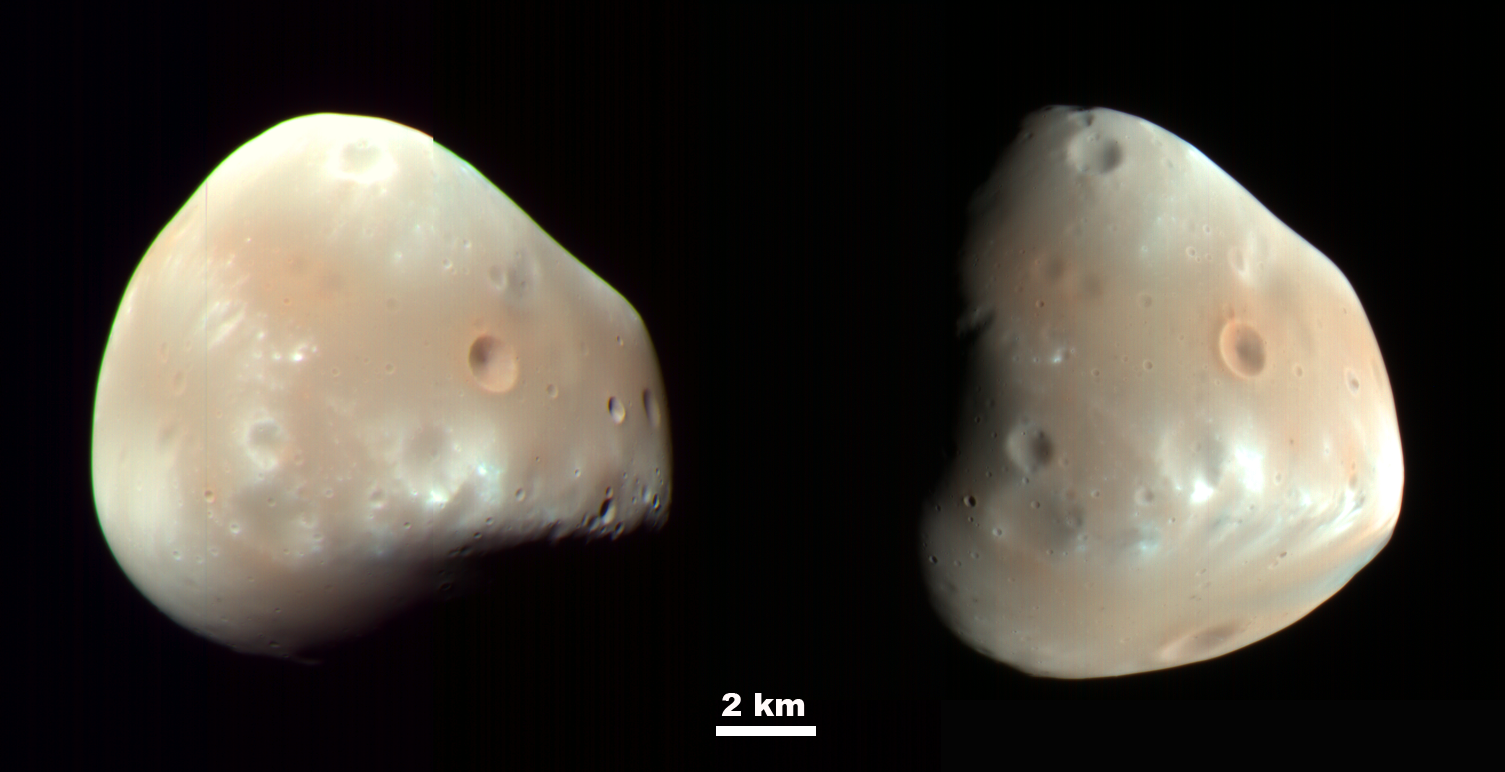
Deimos, Moon of Mars  Credit: NASA/JPL/University of Arizona

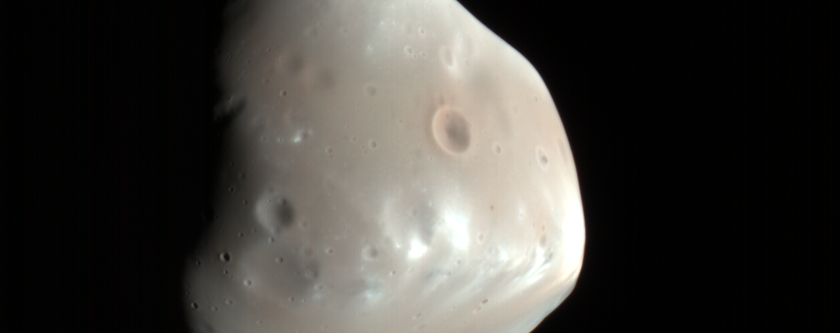
HiRISE captured these enhanced-color images of Deimos, the smaller of the two moons of Mars, on 21 February 2009.

Deimos has a smooth surface due to a blanket of fragmental rock or regolith, except for the most recent impact craters. It is a dark, reddish object, very similar to Phobos, shown here in enhanced HiRISE colors (near-infrared, red, and blue-green). HiRISE took images of Phobos on 23 March 2008.

There are subtle color variations—redder in the smoothest areas and less red near fresh impact craters and over ridges or topographic highs (relative to its center of gravity). These color variations are probably caused by the exposure of surface materials to the space environment, which leads to darkening and reddening. Brighter and less-red surface materials have seen less exposure to space due to recent impacts or downslope movement of regolith.

With an image scale of about 20 meters/pixel, features 60 m or larger can be discerned. The images were acquired 5 hrs 35 minutes apart, so the sun was to the upper left in the first (left) image and to the right in the second image. Although the viewing geometry is similar in the two images, surface features appear very different due to the changes in illumination.

EDR Products
EDR Products for ESP_012068_9000
EDR Products for ESP_012065_9000


POSTSCRIPT

For information about NASA and agency programs on the Web, visit: http://www.nasa.gov. NASA's Jet Propulsion Laboratory, a division of the California Institute of Technology in Pasadena, Calif., manages the Mars Reconnaissance Orbiter for NASA's Science Mission Directorate, Washington. Lockheed Martin Space Systems is the prime contractor for the project and built the spacecraft. The HiRISE camera was built by Ball Aerospace and Technology Corporation and is operated by the University of Arizona. The image data were processed using the U.S. Geological Survey’s ISIS3 software.